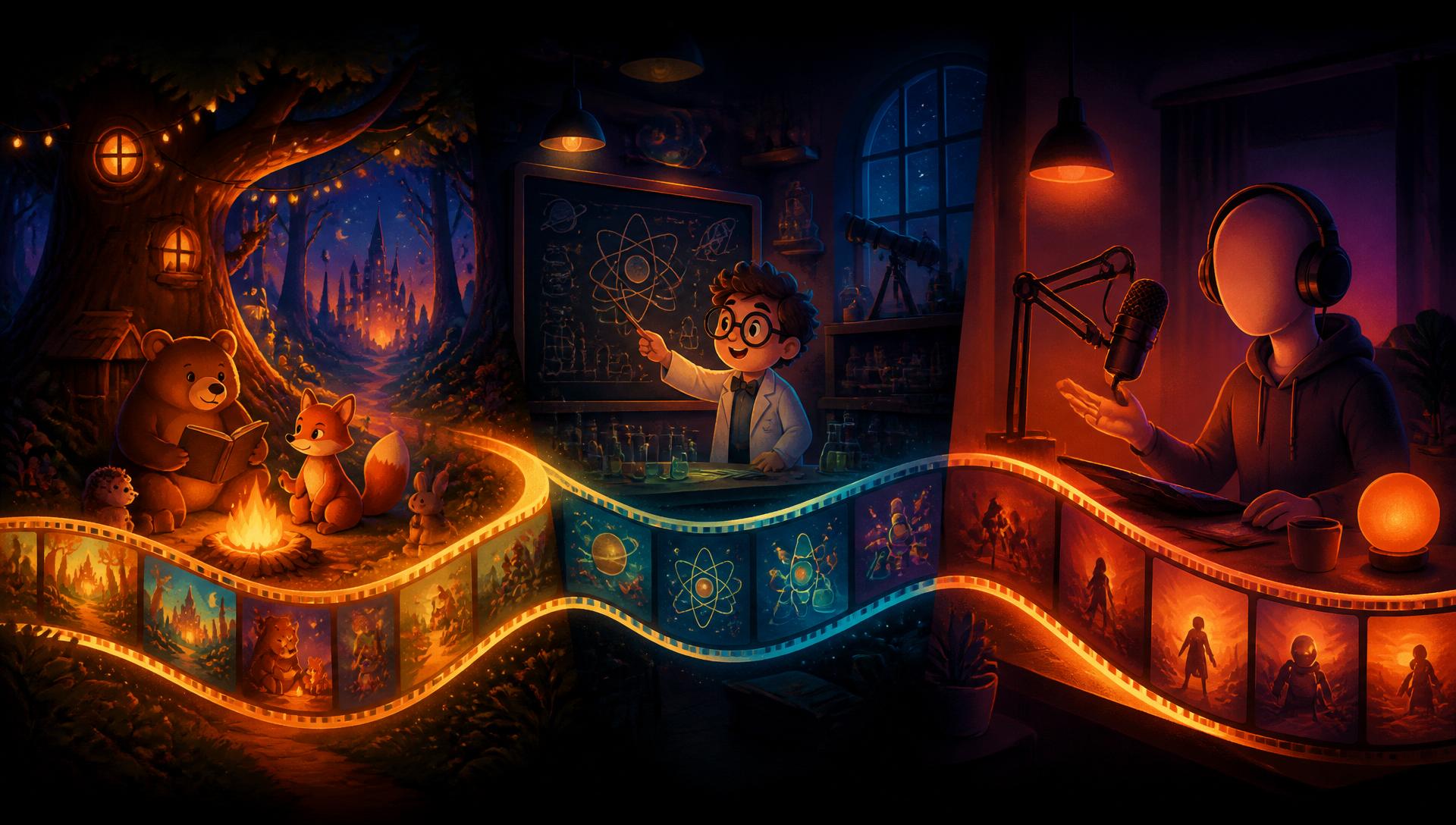
Bedtime stories, explainers, faceless narration, kids learning, brand videos and localised cuts all run through the same eight steps. What changes is the style, the voice and the pacing.
Each one uses the same studio, with different settings at the brief stage.
Bedtime story channels
Long, calm, illustrated stories that run night after night.
Bedtime channels live or die on consistency: the same narrator, the same gentle palette, the same cast of animals turning up week after week. Toonqo locks the art style and cast at the brief stage, so episode twelve still looks like episode one, and the soft narration voices keep the pace slow enough to actually fall asleep to.
Pick a warm, storybook art style once and reuse it for the whole series
Use slow camera drifts and crossfades instead of hard cuts
Keep music low with a deep duck so the voice stays in front
Explainer and science channels
Turn a dense topic into a cartoon that people finish.
Explainers need one clear idea per scene. Because the script is written as numbered scenes, you can see the shape of the argument before any art exists, cut the scene that repeats itself, and only then spend time on frames. Diagrams and metaphors become illustrated stills with a push in to keep attention moving.
Write the script first, approve the structure, then draw
One idea per scene keeps the pacing honest
Use zoom transitions to signal a new section
Faceless narration channels
No camera, no studio, no on screen presence needed.
Faceless formats are the fastest path to a publishing cadence, and the bottleneck is always visuals. Toonqo replaces stock footage hunting with frames drawn for the exact line being read, so the picture is always on topic. Narration is synthesised per scene and the timeline follows the audio automatically.
Batch a week of scripts, then generate art in one sitting
Vary the narrator voice per scene for interview style pieces
Export the asset pack if you like finishing in your own editor
Kids learning videos
Numbers, letters, animals and habits, in a friendly style.
Learning videos repeat a simple pattern with different content, which is exactly what a locked cast and style are for. Build the characters once, then produce an episode per concept. Bright art styles and short scenes keep young attention spans, and the thumbnail generator packages the concept as a big readable headline.
Short scenes with one concept each
Reuse the same two or three characters across every episode
Put the concept word in the thumbnail headline
Brand and product explainers
A friendly cartoon beats a screen recording for onboarding.
For landing pages, onboarding flows and support articles, a ninety second cartoon explains a product faster than a written walkthrough. Set the tone to plain and helpful, keep the cast to one guide character, and export at 1080p for embedding. The share link is enough to get sign off before rendering.
One guide character carries the whole explainer
Keep it under two minutes for landing page use
Share the preview link for stakeholder review
Localised versions
One storyboard, several narration tracks.
Once the frames exist they are language independent. Rewrite the narration text, pick a different voice, and regenerate audio to produce another cut of the same video for a second audience. The timeline reflows to the new durations, so nothing needs manual retiming.
Keep the frames, swap only the narration
Rebuild the timeline automatically from the new audio lengths
Export a separate thumbnail with translated headline text
Who it fits
Built for people shipping regularly.
Toonqo is aimed at the creator who has more ideas than production hours, and who would rather approve work than start every video from a blank canvas.
Weekly publishers
People who need a repeatable pipeline more than a one off masterpiece.
Solo creators
No animator, no voice actor, no editor on call, and no budget for all three.
Educators
Teachers and course builders turning lesson notes into something watchable.
Small teams
Marketing and support teams who need explainers without a production queue.
Pick a format and go.
Start with one line about the video you wish existed. The studio takes it from there.